Anvil
Project Overview
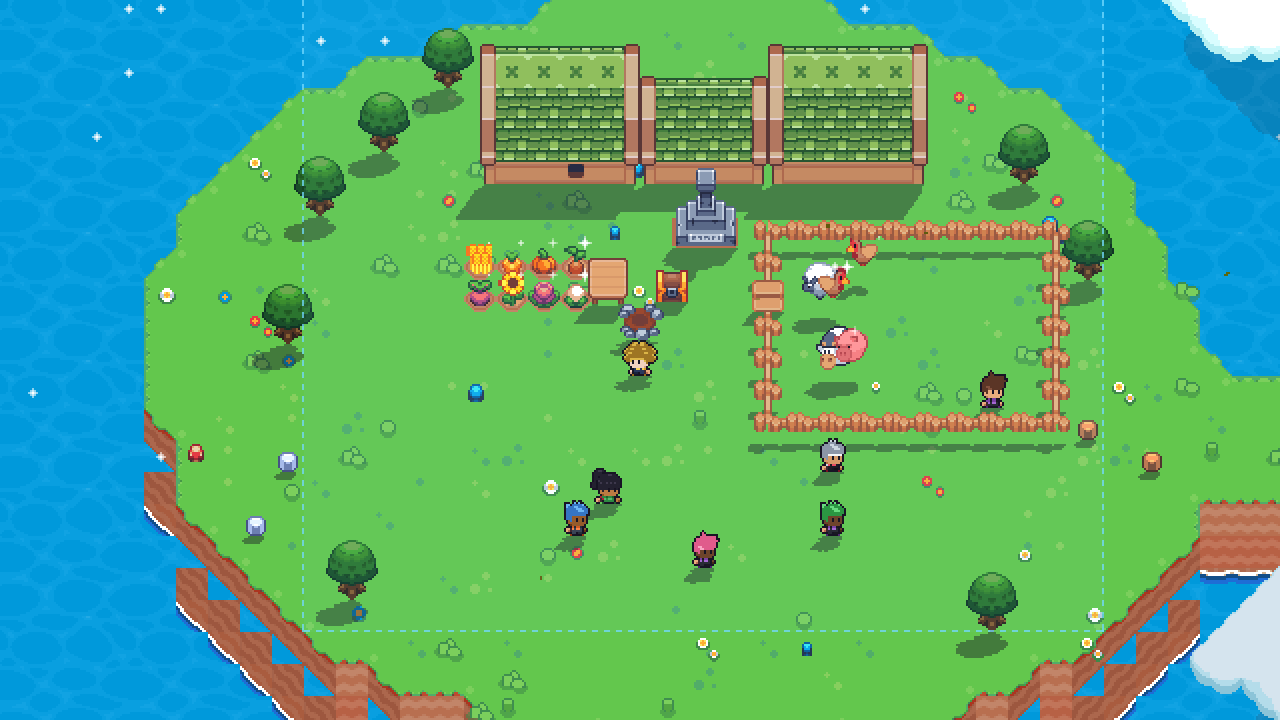
Anvil is a small online world. Everyone who plays is on the same island at the same time: you chop trees, mine rocks, fish off the shore, turn what you gather into tools at the forge, and claim a patch of land to build a house on. The world keeps going when you log off, and so do your workstations.
It started from one sentence I kept coming back to:
Build a life in a persistent world, master the things you enjoy, and gradually turn wilderness into a place that belongs to you and your community.
The influences are easy to spot — RuneScape's click-to-move and long skill grinds, Stardew Valley's cozy pixel art and farming, V Rising's step-by-step base building — but the goal is one coherent game rather than a collection of borrowed systems.
What You Can Do
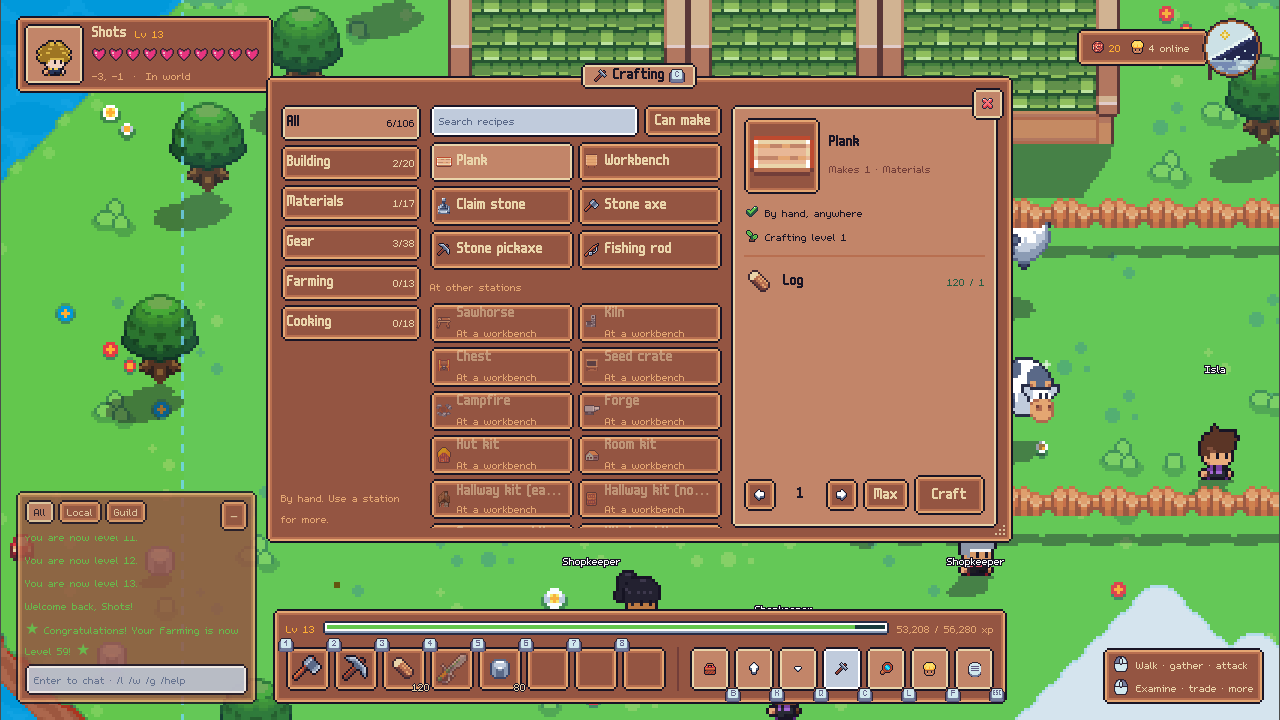
- Train skills from 1 to 99 — woodcutting, mining, fishing, farming, cooking, smithing, foraging and more, plus weapon mastery. Every level makes you a little better, and titles and prestige wait at the top
- Craft at forges, workbenches, kilns, looms and campfires that keep working while you are away
- Farm — till, plant, water and harvest. Crops grow in real time
- Raise animals — catch chickens, ducks, sheep, pigs and cows, pen them, feed them and breed them
- Build a home — claim land, grow the claim, and build a house room by room, upstairs included
- Gear up — over a thousand pieces of armour and weapons, each with its own rolled stats, and set bonuses for wearing a matching set
- Trade — face to face, with vendors, and on the player market
- Be social — chat, friends, and guilds with ranks
Design Pillars
A few rules decide almost every feature:
- Number go up. There should always be something meaningful to improve — a skill, your gear, your house, your farm.
- Cozy by default, challenging by choice. Most content is relaxed enough to play with half your attention. The harder fights are there for people who want them.
- Passive-friendly, active-rewarding. Plant a crop and come back later, or water and fertilise it to grow it faster. Neither player is doing it wrong.
- You can master everything. No skill is locked behind another player. A solo player can become a master miner, smith, farmer and cook. Other players make it more fun, not possible.
The World Is Built Live
There is no procedurally generated terrain. The island is painted by hand, and most of it is painted in game: press F1 as a builder and you get a map editor right inside the running world. Every edit is saved to that world's database on top of a baseline map, and players see it appear as it happens.
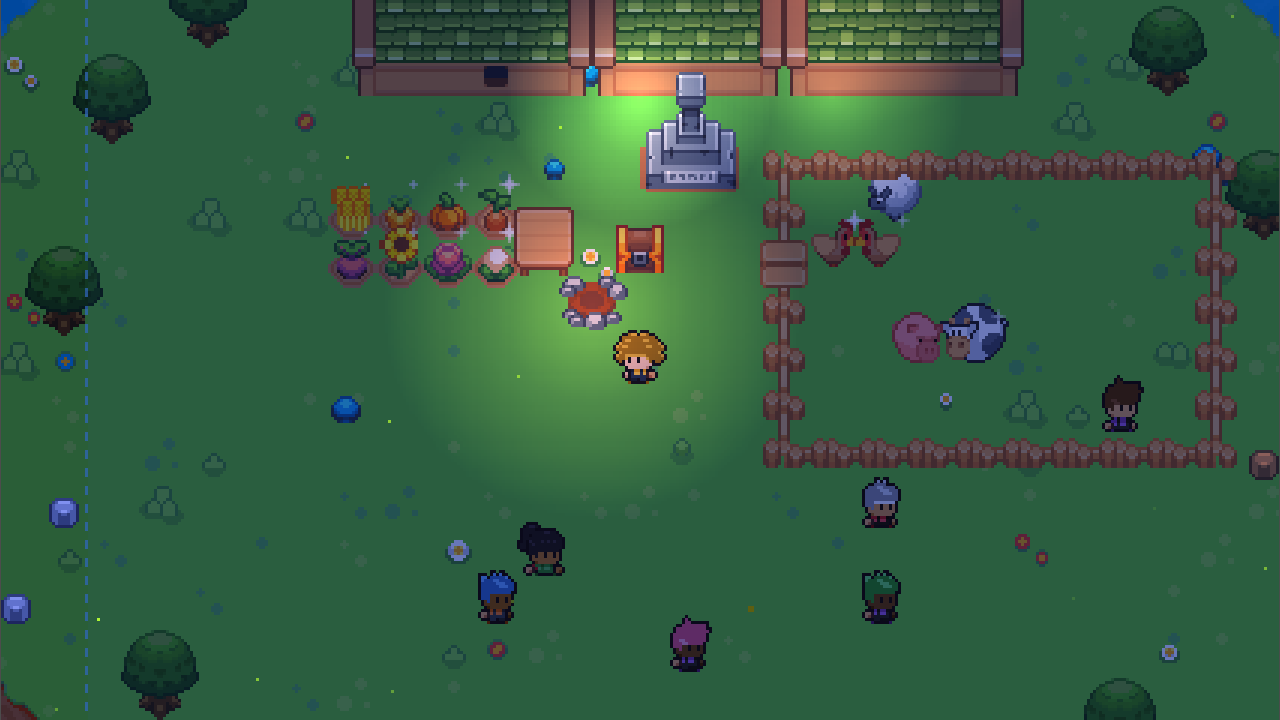
The world has a life of its own too. The seasons turn — autumn colours the trees, winter brings snow — rain showers are shared by everyone online, mist rolls in at dawn, and fireflies come out at night.
Under the Hood
The client is built in Godot 4, and the server is a SpacetimeDB module written in Rust. SpacetimeDB is a database that runs your game logic inside it, so the server's state is the database, and clients subscribe to exactly the rows they need — the chunks of map around them, the players nearby, their own bag.
The interesting part is movement. Clicking to walk can't wait for a round trip to the server, so the client predicts its own path immediately and the server stays the authority. For that to work, the client and the server have to read the map and find paths exactly the same way. Both sides are checked against shared test vectors, and a parity test fails the build the moment they drift.
A few other things I'm happy with:
- One world, every platform. The browser build and the Windows and Linux downloads all connect to the same world with the same account.
- Development happens over the real network. I work against a hosted preview world rather than a local server, so latency, reconnects and how much data a chunk costs show up early instead of on launch day.
- Bot players. One command opens sixteen bot clients in tiled windows that walk, gather and craft, which stress-tests the server, the prediction and the interface all at once.
Play It
Anvil is an early playtest, and it's free. You can play it in your browser or download it on itch.io. Things will break and the balance is rough, but every report shapes where it goes next — Esc → Report a bug sends one straight to me.
If you've ever wanted a cozy MMO where your little corner of the world is still there when you come back, come and claim a plot.